
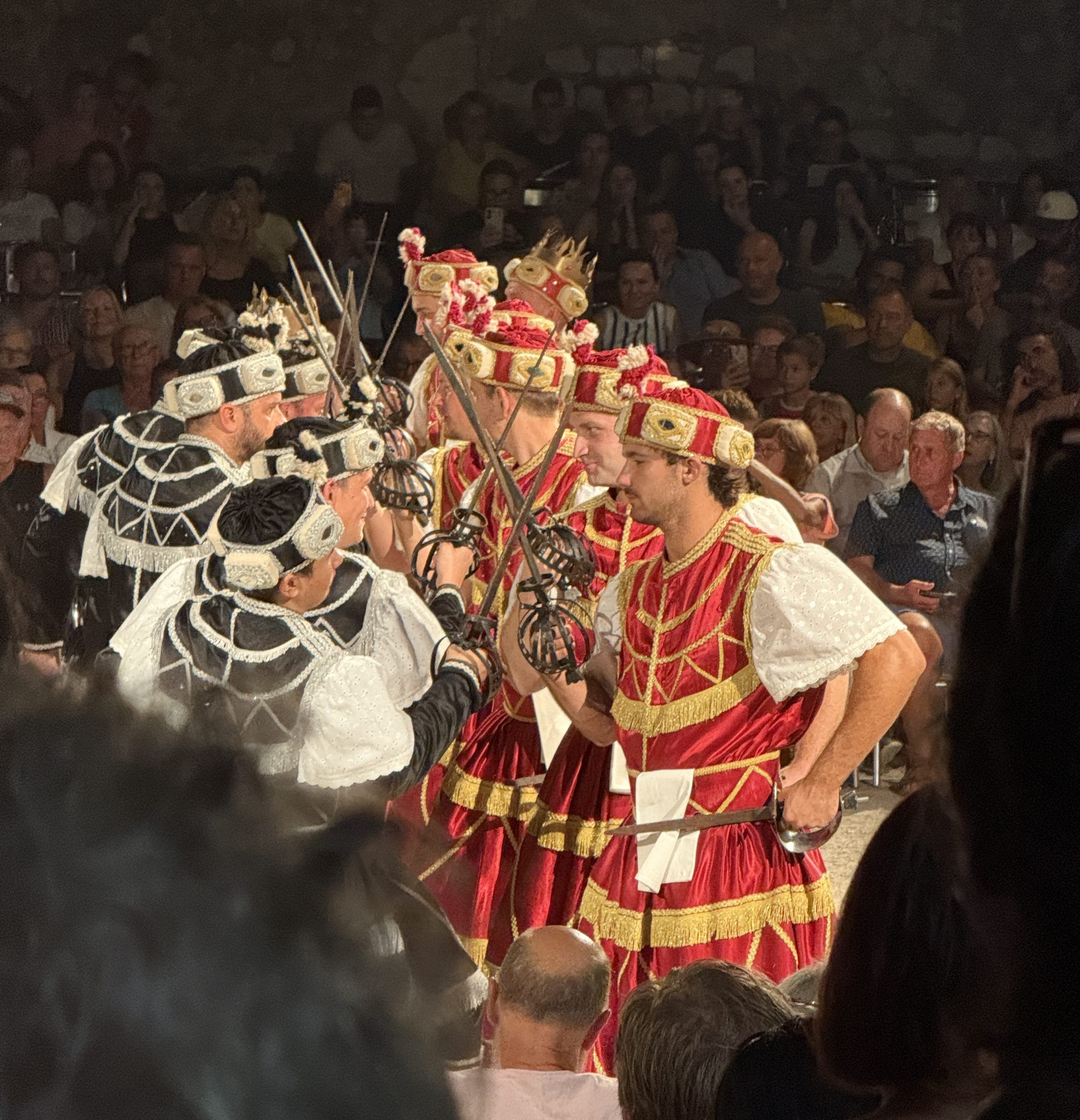
Moreska Sword Dance in Korcula: Tickets, Best Seats, and What’s Really Going On.
We were not sure if we wanted to commit to the Moreška sword dance in Korčula. We were only staying on the island for one night, the performance didn’t start until 9 pm, and we weren’t sure a traditional sword dance was how we wanted to spend our evening. But we decided to give it a chance, and I’m happy that we did.
Even though we somehow managed to end up with what might have been the worst seats in the house, spent the entire performance sweating in the sweltering night air, and couldn’t understand most of the dialogue, there was something undeniably captivating about watching a centuries-old tradition unfold in the heart of Korčula’s Old Town.
This guide is what we wish we knew before attending. It includes how to get tickets, which nights it’s on, where to sit, and a plain-English, scene-by-scene guide to what’s actually happening on stage.
Only in Korcula for a night? See how the Moreska fits into our one night in Korcula itinerary.
Short answer: is the Moreska worth it?
Yes, if you have a free evening on a show night. It costs €20 (2026 price), lasts about an hour, and Korcula is the last place in the world where this dance is still performed live. Book ahead of time in July and August, arrive 30 minutes early for a central seat, and read our scene-by-scene guide below so you can follow the story.
Moreska quick facts
| Moreška Sword Dance, Korčula | |
|---|---|
| 📅 Season | Late April through mid-October The 2026 season ran from April 29 to October 17 |
| 🕘 Start time | 9:00 pm The final show of 2026, held indoors, started at 7 pm |
| 🗓️ Days | One or two evenings a week, up to three in peak weeks Days change by month |
| ⏱️ Length | About 1 hour |
| 💶 Price | Adults: €20 Children 4–14: €10 Under 3: Free 2026 prices |
| 📍 Venue | Summer Cinema (Ljetno kino), open-air Moves indoors to the Korčula Cultural Center if it rains |
| 💺 Seating | First come, first served |
| 🚪 Doors | About 30 minutes before the show |
| 🎟️ Tickets | Online, at local travel agencies, or at the entrance |
How to get Moreska tickets
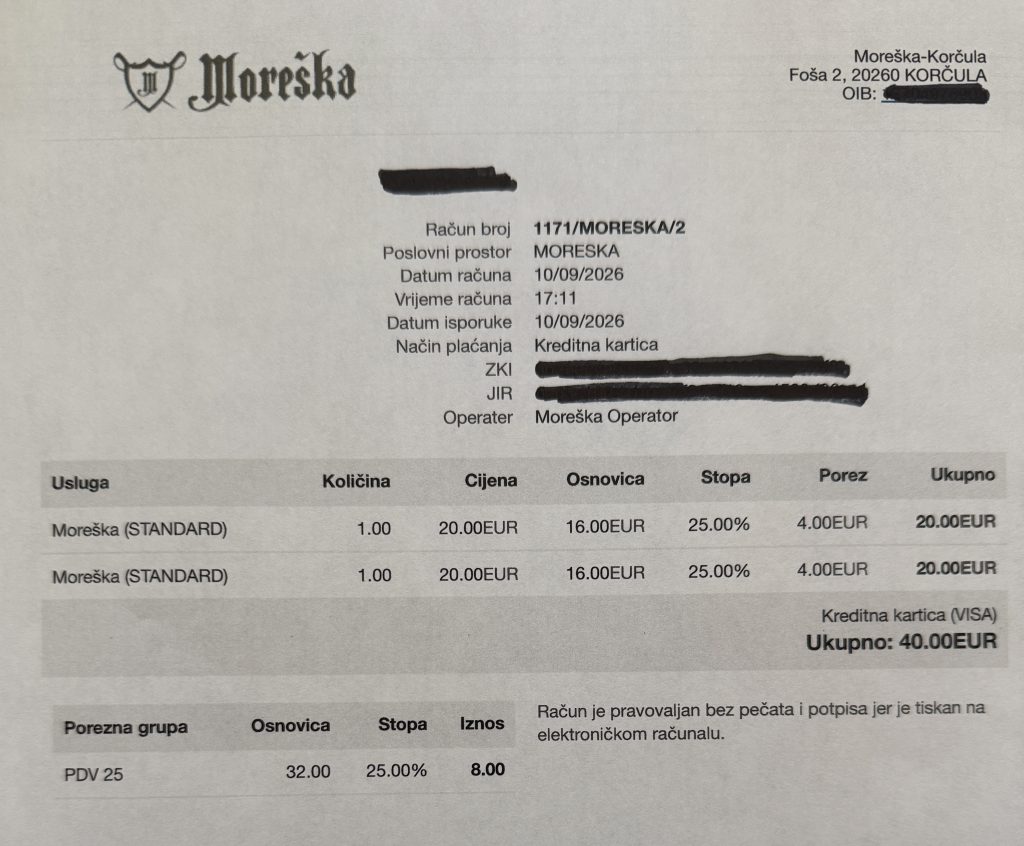
We purchased our tickets online at moreska.eu the afternoon of the performance for €20 each, and the process was straightforward. Simply select your date, choose the number of adult and children’s tickets, and complete your payment. You’ll receive an electronic ticket to present when you arrive.
We were able to purchase ours just a few hours before the show, but keep in mind that we visited outside peak tourist season. If you’re planning to attend during the busy summer months, I’d recommend booking further in advance.
Your Options For Tickets:
- Online. The easiest way to lock in your night, especially in July and August. moreska.eu is run by HGD Sveta Cecilija, the local society that has performed the Moreska since 1883.
- Travel agencies in town. Several agencies just outside the old town walls sell tickets.
- At the entrance. Possible when it isn’t sold out, but you risk missing it on a busy night.
Which Website Should You Use?
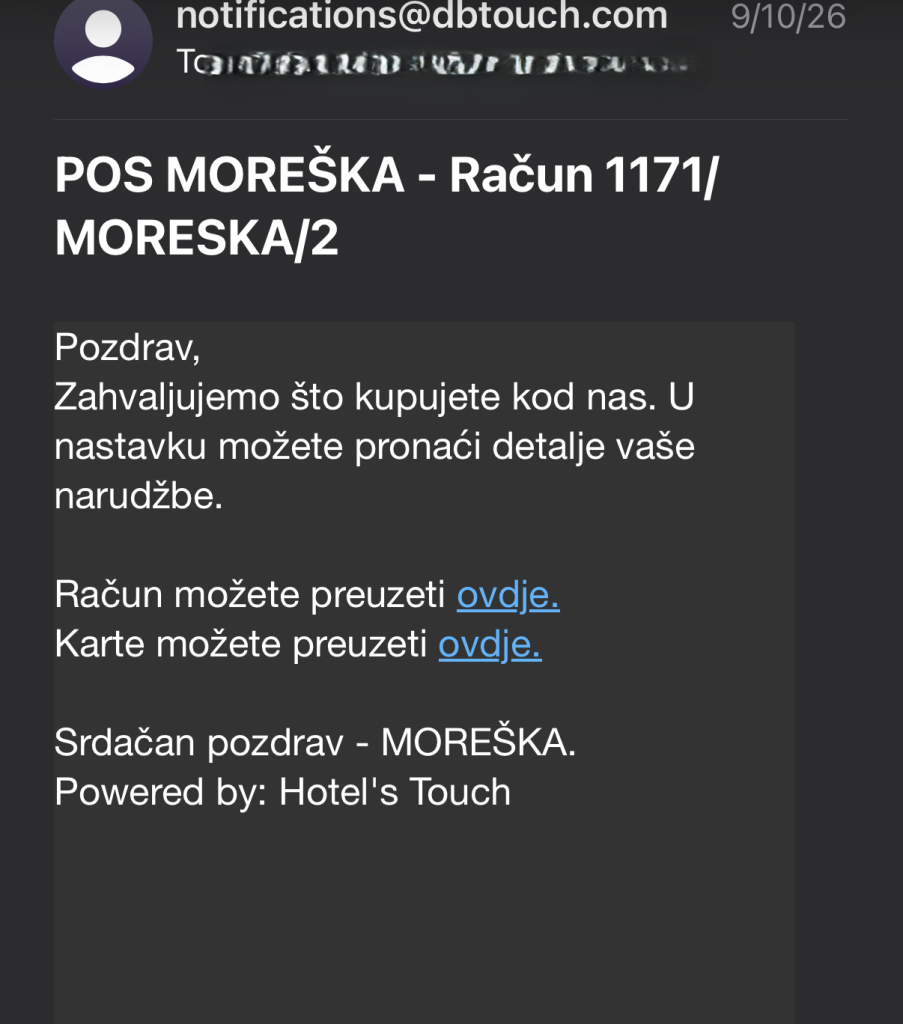
You’ll see more than one Moreska ticket site. Korcula-moreska.com now redirects to moreska.eu, the site of HGD Sveta Cecilija, and Visit Korcula also links to moreska.hr. Whichever site you use, check the date, time and venue on your ticket. The image below was the email confirmation I received right after I finished purchasing our tickets.
Plan Your Korcula Stay Around The Performance
Performances run on only a couple of nights a week, at 9 pm, so check the schedule before you book your ferry and hotel. When we visited in September, our one night happened to be a show night. The 2026 season ended on Saturday, October 17, with a 7 pm show indoors at the Cultural Center.
Moreska schedule: which nights it’s on
| Moreška Show Schedule by Month | ||
|---|---|---|
| Month | Typical show nights | Venue |
| Late April | One opening show Wednesday, April 29 in 2026 |
Summer Cinema |
| May | Mondays and Wednesdays 2026 schedule |
Summer Cinema |
| June–August | Mostly Mondays and Thursdays, with extra nights in peak weeks August 2025 had 10 shows |
Summer Cinema |
| September | About two a week, mostly Mondays and Thursdays We went on a Thursday |
Summer Cinema |
| October | The last few shows of the season In 2026: Mon Oct 12 and Wed Oct 14 (9 pm), plus a final show Sat Oct 17 (7 pm) |
Summer Cinema Oct 17 show at the Cultural Center |
| ⭐ July 29 | St. Theodore’s Day, the Moreška’s traditional date | Check the program |
In Korcula in Early September?
Look for the Korčula Sword Dance Festival. In 2026 it ran from September 2 to 13, with free performances of all three of the island’s sword dances in Korcula Town and the villages.
Our visit actually fell during the 2026 festival, but we didn’t know about it at the time, so check the festival program before you buy tickets. You might be able to catch a free performance instead.
The venue and where to sit
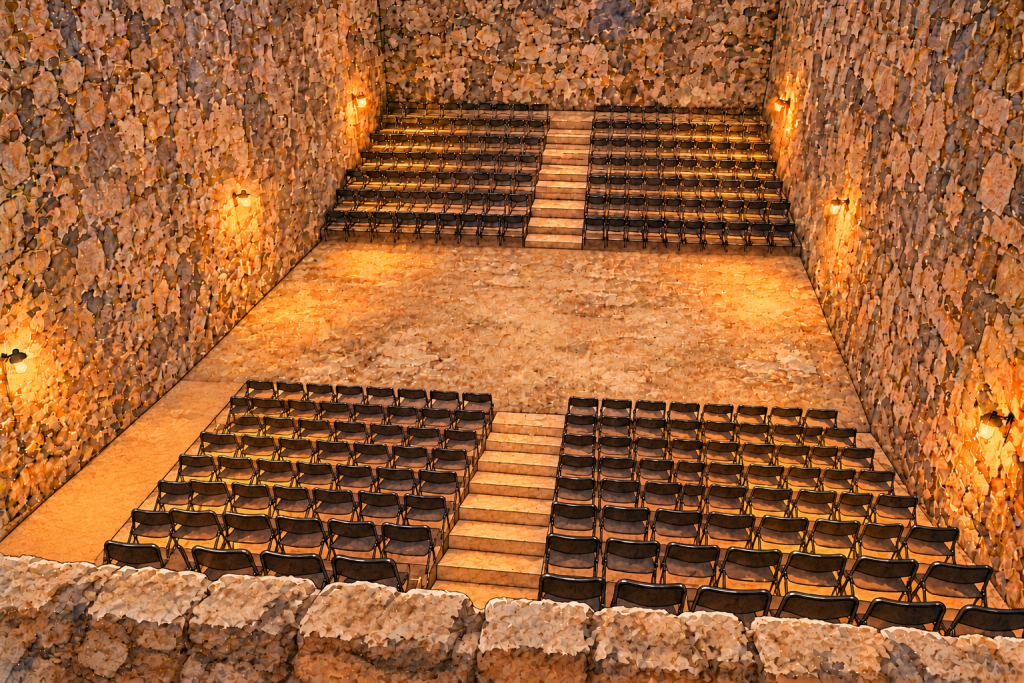
In good weather, the Moreska is performed at the Summer Cinema (Ljetno kino), an open-air venue just outside the old town, close to the main Land Gate.
If it rains, the show moves indoors to the Korcula Cultural Center. Check your ticket on the day.
The Summer Cinema is open to the sky but enclosed by walls, which gives it a great atmosphere, especially with the iron swords ringing off the stone. The downside is that there’s no breeze. Even at 9 pm in September, it was stifling.
Practical advice on how to get there
We were heading to the show from the other side of the historic center of Korčula. When heading to the Summer Cinema (Ljetno kino) we could have walked straight across (up the stairs and then back down the stairs through the center of town), or around by following the path along the water. Because it was hot outside, we decided to follow the path around the center of Historic Korčula. The path we took was a little bit longer, but both routes would realistically only take a few minutes.
The entrance is to the left of the grand stone staircase leading into Korčula’s Old Town (which is commonly called the Revelin Staircase or the stone staircase leading to the Land Gate (Kopnena Vrata)). Do not go up the staircase, just go to the left where you will see a doorway, and possibly a line waiting to get inside.
Seating is first come, first served
There are no assigned seats, and doors open about 30 minutes before the show. We arrived about 10 minutes before the start and took the only two seats together we could find, which were high up, right beside the band.
Our seating advice:
- Arrive when the doors open (around 8:30 pm) if you want to choose.
- Sit centered and a few rows back. The fight is choreographed in circles, and a central view lets you see the formation tighten, which is the whole point of the final battle.
- Avoid sitting right beside the band if you’d rather hear the swords than the brass.
- Grab the English translation as you go in. We missed ours because we arrived late.
What’s actually happening on stage
The Moreska is a love story told as a battle. Two kings fight over a captive princess, and the good king wins her back. The dialogue is in a 17th-century Korčulan dialect. Here’s who’s who and what happens, in order.
The characters
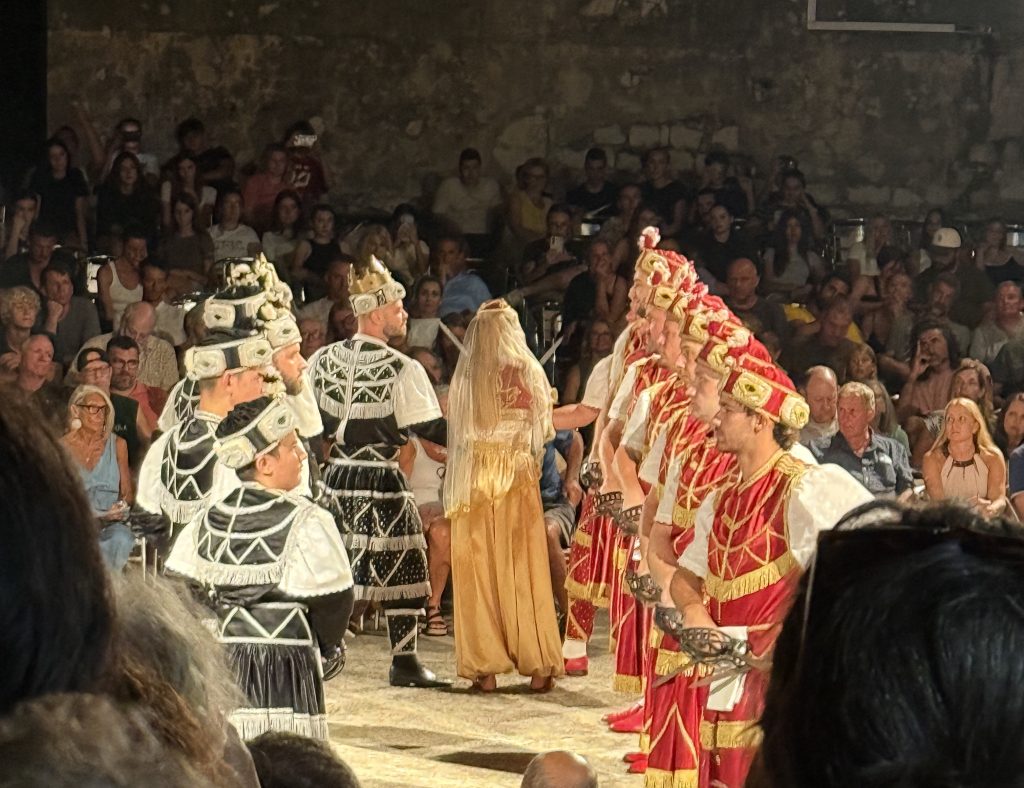
- The Bula, the princess, held captive. She’s the only main role that isn’t a fighter.
- The White King, Osman. The hero, here to reclaim the Bula, his bride-to-be. Confusingly, the White army wears red.
- The Black King, Moro. He has taken the Bula by force and wants her for himself. He and his army wear black.
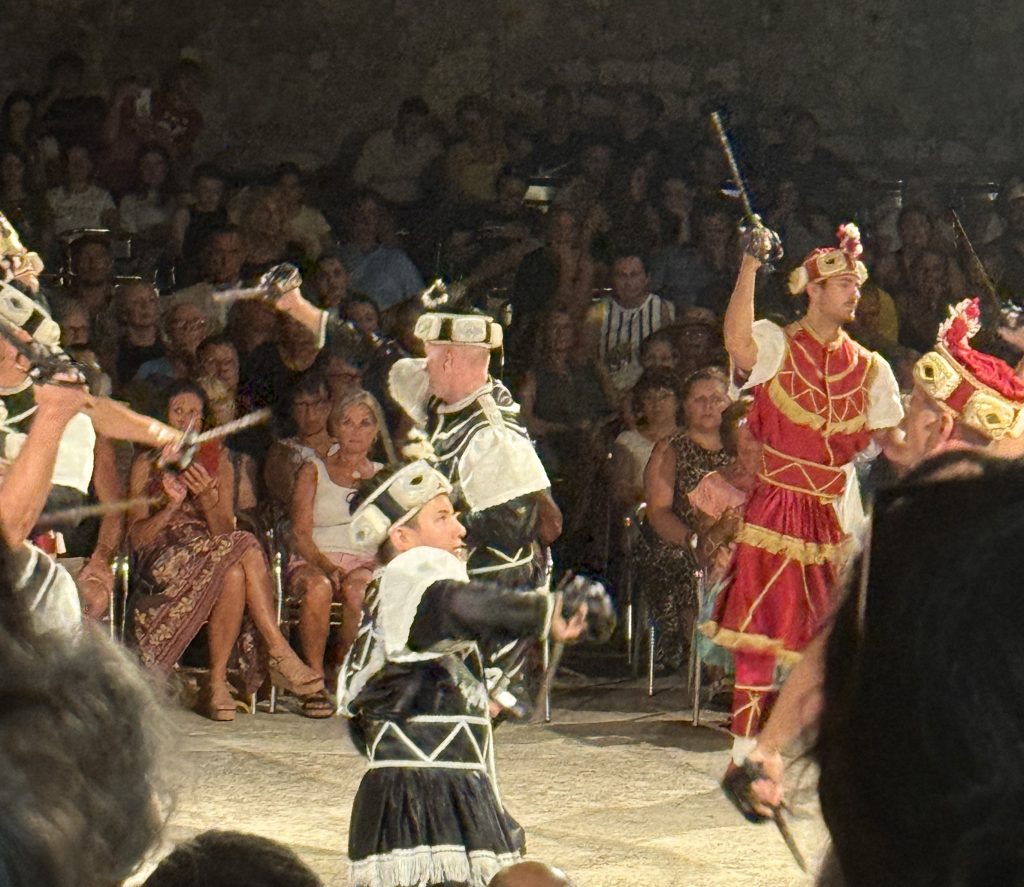
- The two armies. Each dancer carries two heavy iron swords: the right hand strikes and the left blocks.
The performance, scene by scene
- The klapa. The evening opens with a small group singing traditional Dalmatian a cappella songs. These were six singers who opened our show.
- The story is introduced. Before the fighting, the story is narrated in several languages, so listen for a language you know.
- The confrontation. Moro tries to win over the Bula, who rejects him and says his unwanted love hurts her more than any sword. Osman arrives to take her back.
- The Sfida (the challenge). The two kings trade challenges, and the duel begins.
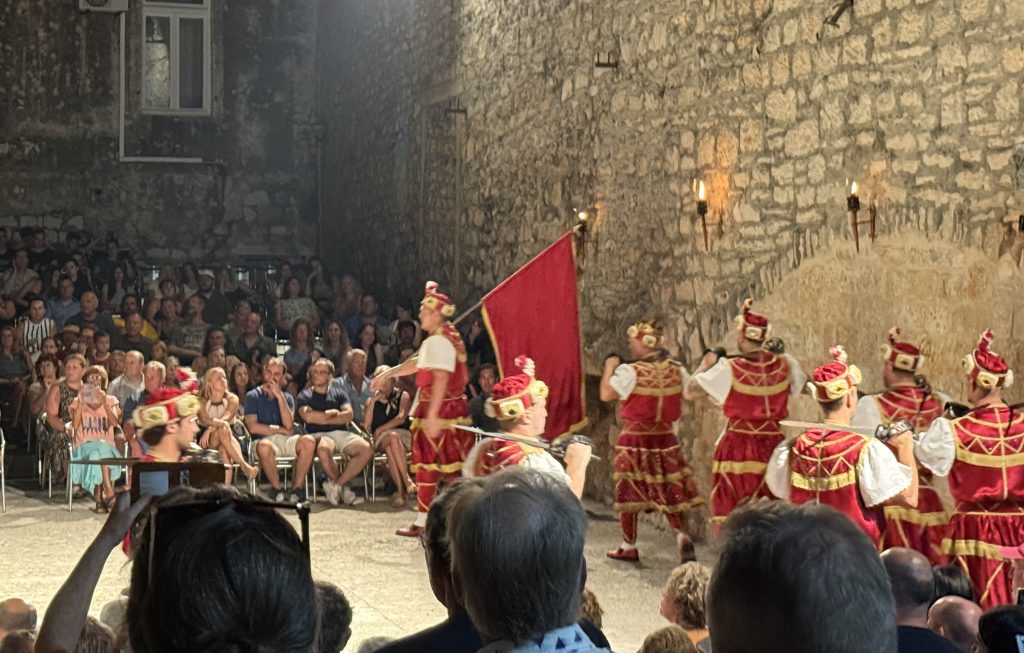
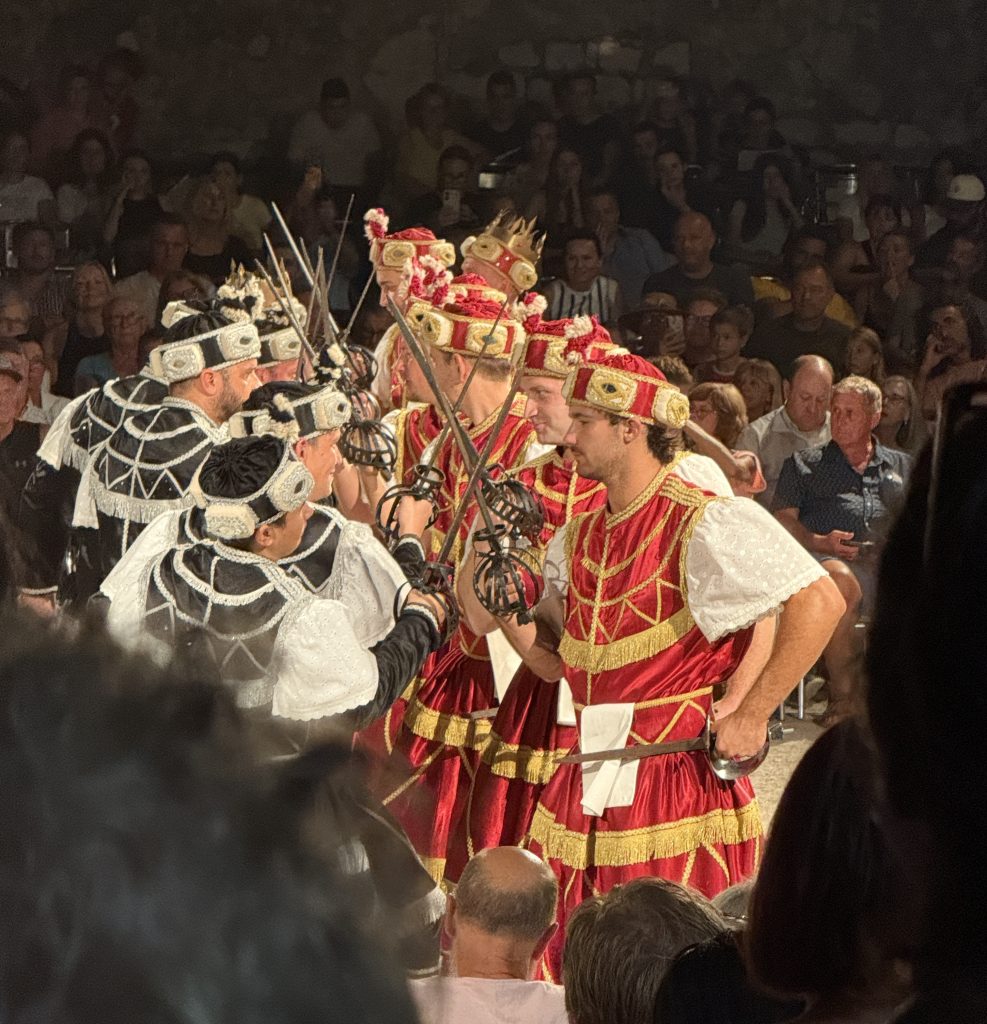
- The seven battles (kolapi). The armies fight through seven sword-dance figures, each faster and fiercer than the last: Rugier, Moreška, Finta, Moro in dentro, Križ, Rugier de fuorivia, and a final figure danced at full speed. Watch the Black army’s circle: it gets smaller with each figure as they’re surrounded.
- The surrender. Moro lays his sword at Osman’s feet. The Bula is freed, and the good king wins.
What to watch and listen for: The clash of iron on iron, which is loud enough that sparks can fly. The live brass band driving the tempo higher in each figure. And the ring of fighters tightening around the Black King’s army.
A note on the history in the story. The dance began as a reenactment of Christian armies fighting the Moors in Spain, and in Korcula the two sides have also been read as Croats and Ottomans.
A short history: from Spain to Korcula
- Around 1150, Lérida, Spain. The earliest recorded Moreska-style performance marks a Christian victory over the Moors.
- The centuries that followed. Sword dances like it spread around the Mediterranean, from Spain to Sicily, Venice and the Greek islands.
- 1666, Korcula. The first written record of a Moreska in Korcula, performed during carnival.
- 1883. HGD Sveta Cecilija, a local singing society, is founded and becomes the Moreska’s home.
- Today. Every other Moreška has died out, so Korcula’s is the last one still performed. The dancers are traditionally men from local families, and boys start learning the steps in elementary school.
Traditionally the Moreska was danced on July 29, the feast of St. Theodore, Korcula’s patron saint. Now it’s performed through the summer season.
Moreška vs. Kumpanija and Moštra: Korcula’s other sword dances
The Moreška isn’t the only sword dance on the island. In the villages, you can see the Kumpanija, performed in Pupnat, Čara, Smokvica, Blato and Vela Luka, and the Moštra from Žrnovo.
- Moreška (Korcula Town): a staged drama with two kings, a captive princess and two armies, each dancer fighting with two swords, to a live brass band.
- Kumpanija (the villages): men with long swords move in formation under a captain’s commands, to bagpipes and drums, and finish with the tanac, a circular chain dance. It’s mostly danced at village feast days in summer.
If you love the Moreška, catch a Kumpanija in a village, or see them together at the Korčula Sword Dance Festival in early September.
Our night at the Moreska
We saw the Moreska on a Thursday night in September 2026. We’d spent the early evening having drinks at Massimo, the cocktail bar on top of a tower, and lost track of time. We left with about 15 minutes to spare and the walk took about five.
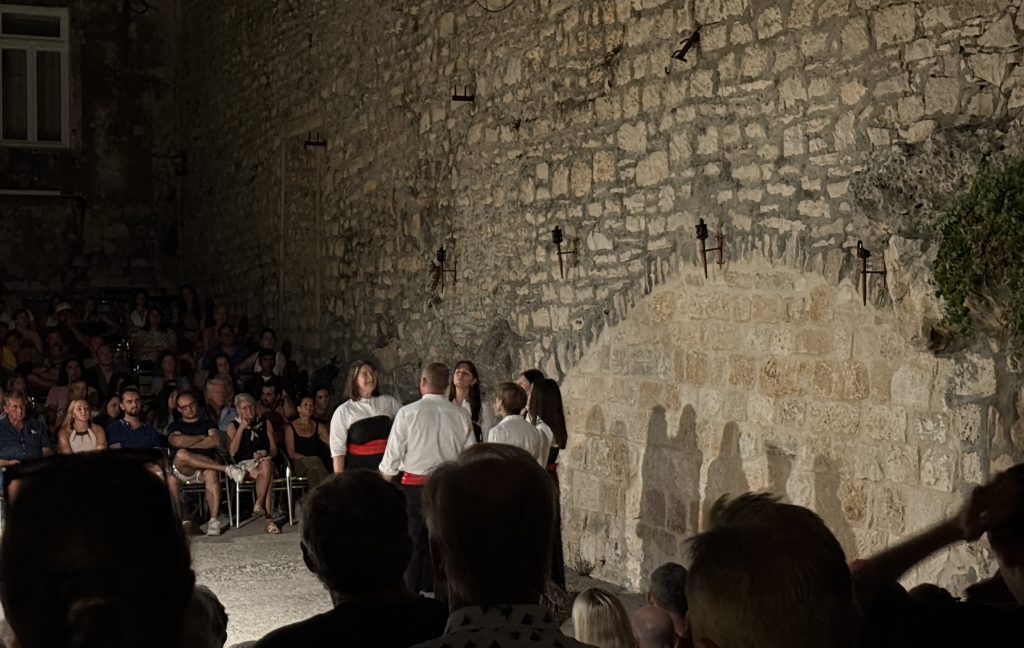
Because we arrived just before the start, the good seats were gone. We found two together high up next to the band, and we missed the translation sheet. The show opened with the singers, then the actors playing the Bula and the kings acted out the setup before the two armies marched in. The sword fighting itself held us captive for the entire show. We found it interesting even without understanding the words, and we’d have enjoyed it even more knowing the story.
The first clash of swords caught me a little off guard. As the performance unfolded, the dancers grew more animated, and sparks flew each time their swords collided. The intensity continued to build until the Bula was finally reclaimed, drawing cheers from the crowd.
The hardest part of the show was the heat. With walls all around and no breeze, it was stifling, even at 9 pm in September.
Tips for the Moreska
- Book ahead online in July and August, and plan your Korcula stay around a performance night (see the schedule above).
- Arrive when doors open, about 30 minutes early, for a central seat.
- Pick up the English translation on the way in.
- Read the story above before you go. Knowing who’s who makes the fighting far more exciting to watch.
- Dress light and bring water. In midsummer, a small fan is a good idea too.
- Plan dinner around it. The show ends around 10 pm, and many kitchens close soon after. Eat beforehand or book a late table. (Our one night in Korcula post has the story of our near-miss.)
- Don’t film the whole thing. A short clip of the final battle is plenty to keep for later. The show is better seen live.
- Go in early September for a bonus. The Korčula Sword Dance Festival offers free performances of the Moreška, Kumpanija and Moštra around the island.
Moreska FAQ
What is the Moreska?
A sword dance and drama from Korcula in which two kings and their armies fight over a captive princess. It’s the last surviving version of a dance once performed across the Mediterranean.
How much are Moreska tickets?
In 2026, €20 for adults, €10 for children 4–14, and free for children 3 and younger. We’ll update this when 2027 prices are announced.
When is the Moreska performed?
From late April to mid-October, usually at 9 pm, on one or two nights a week (more in peak weeks). Days change by month, so check moreska.eu.
How long is the Moreska?
About an hour, including the opening songs.
Where is the Moreska performed?
At the open-air Summer Cinema (Ljetno kino) in Korcula Town, or the Korcula Cultural Center if it rains.
Are seats assigned?
No. Seating is first come, first served, and doors open about 30 minutes before the show.
What language is it in?
The dialogue is in an old Korčulan dialect, but the story is narrated in several languages first, and an English translation of the words is available at the venue.
What does “Moreska” mean?
The name Moreška in Croatian is linked to the Moors, the North African Muslims who ruled much of Spain, where the dance is thought to have originated.
What’s the difference between the Moreška and the Kumpanija?
The Moreška is Korcula Town’s sword drama about two kings and a princess. The Kumpanija is a village sword dance led by a captain, danced to bagpipes and drums. You can see both at the Korčula Sword Dance Festival in early September.
Wrapping Things Up: Our Verdict
For €20 and an hour of your evening, yes, if you go in knowing what you’re watching. It’s a rare chance to see a tradition that has all but disappeared elsewhere, performed by locals whose families have danced it for generations.
You’ll love it if you enjoy local culture, live music, or history, or you want something to do in Korcula after dark besides eating and drinking.
You might skip it if you’re not into staged performances, you struggle in heat (in midsummer especially), or you’d rather spend a short visit on the water.
Our verdict: For us, it was a once-in-a-lifetime opportunity to see a performance of an ancient cultural tradition that we likely won’t have the opportunity to see again. We were glad that we went!
